

If homeopathy is going to be used by the masses, it has to be user friendly.
And this is one of the great gifts given to us by the Drs. Banerji.
The clinically-tested homeopathic protocols that they published offer us far more than just some protocols for some conditions.
The protocols can also serve as a guide for how to use homeopathy— at minimum showing us a nice, safe place to begin— and also teaching us how we might use a homeopathic medicine on its own that we don’t have any experience with.
The Banerji Protocols can also be used as a template for selecting the potency and frequency for a great many homeopathic medicines.
And for many people, the hardest part is not choosing which homeopathic remedy they want to try, but knowing whether to use a 6X, 6C, 30C, 200C (or even higher) and then deciding how often to take it.
The term posology refers to the art and science of dosing a particular medicine for a particular person. Many will tell you that posology is the hardest part of using homeopathy. However, with the Banerji Protocols, we are given an expert shortcut.
If you have been following me for long, you already know that I do not subscribe to the ‘Classical’ method of homeopathy, where a dose (or a few) are given and then you wait and see.
What I generally use as the starting place in many, many homeopathic cases are the Banerji Protocols.
It’s been a while since I’ve written about The Banerji Protocols, so you might have missed some important articles on the subject:
In brief, Dr. Prasanta Banerji and Dr. Pratip Banerji, the father and son team of medical doctors and homeopaths (both now deceased), worked tirelessly in their overflowing clinics in India.
Over the decades (and generations) they developed clinically tested homeopathic ‘protocols’— meaning this homeopathic medicine for that condition.
(Often more than one homeopathic remedy is used at a time, and typically repeated daily or weekly for an extended period.)
Their only book, The Banerji Protocols— A New Method of Treatment with Homeopathic Medicines, is where they published these protocols.
Additional Banerji Protocols from the Clinic, was written by Nimisha Parekh who visited the clinics in India and observed additional protocols that were used in practice. (You could consider this a companion to the original book.)
In the Banerji Protocols we often find up to three ‘lines’ of protocols:
• The first line is to be considered as the starting place in all cases.
• Line 1 is the protocol that was shown to help 80% or more of the cases with that particular diagnosis.
• Line 2 was for when/if the first line did not act. (With chronic cases we are talking about over months, not just days.)
• Generally speaking, if the first line was acting, with any improvements, or even a halting of the progression of the disease to start— and not necessarily cured— then that protocol would be continued, taking it as far as it would go.
• The second line was for the additional 10-20% of people who didn’t respond to the first line.
• And the same with the third line, if there was one— this was for the 5-10% of people who didn’t respond to Lines 1 or 2. (Lines 2 and 3 could also be utilized if Line 1 was helpful for a while and then stopped acting.)
Having worked with these protocols for many years now, there is some nuance to this. But it still serves as an excellent starting place— especially for beginners who are just getting going with homeopathy, or for those interested in a more practical approach to homeopathy.
Of course, not every condition will be covered in the approximately 230 pages of published Banerji Protocols.
And, yet, the depths of what can be mined from these pages is hard to express without providing some examples. And so that’s what I will do below.
The Banerji Protocol books can serve as excellent templates for anyone who is using homeopathy.
And it pays to revisit the pages time and again. It seems that every time I look through them I notice something I had forgotten, or see something in a way I hadn’t before.
If you only flip through the listed conditions, discarding them as ‘not what I have’, you will miss an incredible depth of information, which to the untrained eye is hiding in plain sight.
We must examine how these homeopathic doctors employed certain medicines—
-noting what potency and frequency they selected;
-what conditions or parts of the body the medicines were used for over and over again;
-and never overlooking the small notes such as ‘in case of bleeding’, which show up within specific protocols but which are not only for that one protocol.
We will also take note of the types of conditions that they repeatedly used certain homeopathic medicines for.
We will discover that many of the homeopathic medicines are not just ‘for’ one specific diagnosis, but are employed in many related conditions.
Before we get into examples, a note about something that I have realized about The Banerji Protocols through much experience and practice:
Imagine if you were publishing a book with a bunch homeopathic protocols.
You would likely include the most tested options.
And when trying to determine the exact details to share with the general population (because, of course, in actual practice there is a going to be variation), you would select the potency and frequency the were the most likely to help the most people the majority of the time— without supervision.
In a nutshell, the Banerji Protocols are conservative.
Very often patients of the Banerjis would have traveled great distances to see them. They would get their medicines and then go back home for months at a time. These people were not getting daily check-ups, input, or providing feedback. So what they were given needed to be generally safe and effective over time.
The frequency, in particular, is where I find the protocols to be especially conservative. (And sometimes the potency as well.)
Over time these protocols would be effective, but in the short term it might not seem like much was happening.
Which is okay IF you can be patient. But most Americans want results now, yesterday even. So, in our Western give me-a-solution-that-works-right-this-second mindset, this is important to understand this or we will miss out on the goldmine that is the Banerji Protocols.
To give you an example:
Aurum Metallicum 200C is recommended in the protocol for depression at a frequency of one dose every third day.
And over time (months) that will be helpful for a lot of people.
However, if I have someone that I am helping and they say, ‘man, I LOVE the days I get to take Aurum and I sure wish I could take it again sooner’…
That is the cue to give it more often.
Pretty regularly my people end up taking the Aurum Metallicum every day, and in some cases even twice a day.
We should not be afraid of these remedies, fearing that if we take them more often they will be damaging, or go against some hidden, ‘master design’ of the Banerjis. Again, this frequency was the balance of safe and effective for the most people, unsupervised, over time.
And there are instances where the Banerjis did give Aurum Metallicum more often.
Just get out the Banerji Protocol books, and take a look at everywhere Aurum Metallicum shows up. It doesn’t take that long to scan your finger down each page.
You will find that Aurum Metallicum actually is used from every third day, to every other day, and in some cases twice a day.
For example, in the Additional Banerji Protocols book on page 44 we find a protocol for—
Mental Symptoms:
Aurum Met 200 twice a day
Ignatia 200 twice a day
Coffea Cruda 200 twice a day
(Yes, all three of these homeopathic medicines. They are great ones for a wide variety of mental and emotional conditions— including insomnia, grief, stress, feeling emotional and overwhelmed, anxiety, fear, lack of motivation, hyperactivity, suicidality, you name it.)
So, when in doubt, start with most conservative and least frequent dosing, and then adjust if needed. Such as in the example above, you might begin with one dose every third day, and then bump it up if needed. (And if you get stuck, find a professional!)
However, if you are just sending someone off to take a protocol on their own, then I would follow the protocol as written.
(Many times I have shared protocols with people, who gave them to friends or family, and I heard back even years later about how helpful they were.)
Now, let’s break it down so you can do this on your own…
How to Use The Banerji Protocols as a Template When Selecting Homeopathic Potency and Frequency—
Let’s start with a very simple example.
Say you’ve done your own research using a Homeopathic Repertory and Materia Medica, and you want to start using the homeopathic medicine, Graphites.
But you have no idea which potency to choose or how often to take it.
Get out your Banerji Protocol books and run your finger quickly down each page looking for everywhere that Graphites is utilized.
These are the protocols that employ Graphites (using both Banerji Protocol books, see links above)—
Entropion and Ectropion
Otitis (Ear Infection)
Seborrheic Dermatitis and Dandruff
Ringworm (and Fungal Infections)
Atopic Dermatitis (aka Eczema)
Obesity
Scars (see photo below)
Wound Healing
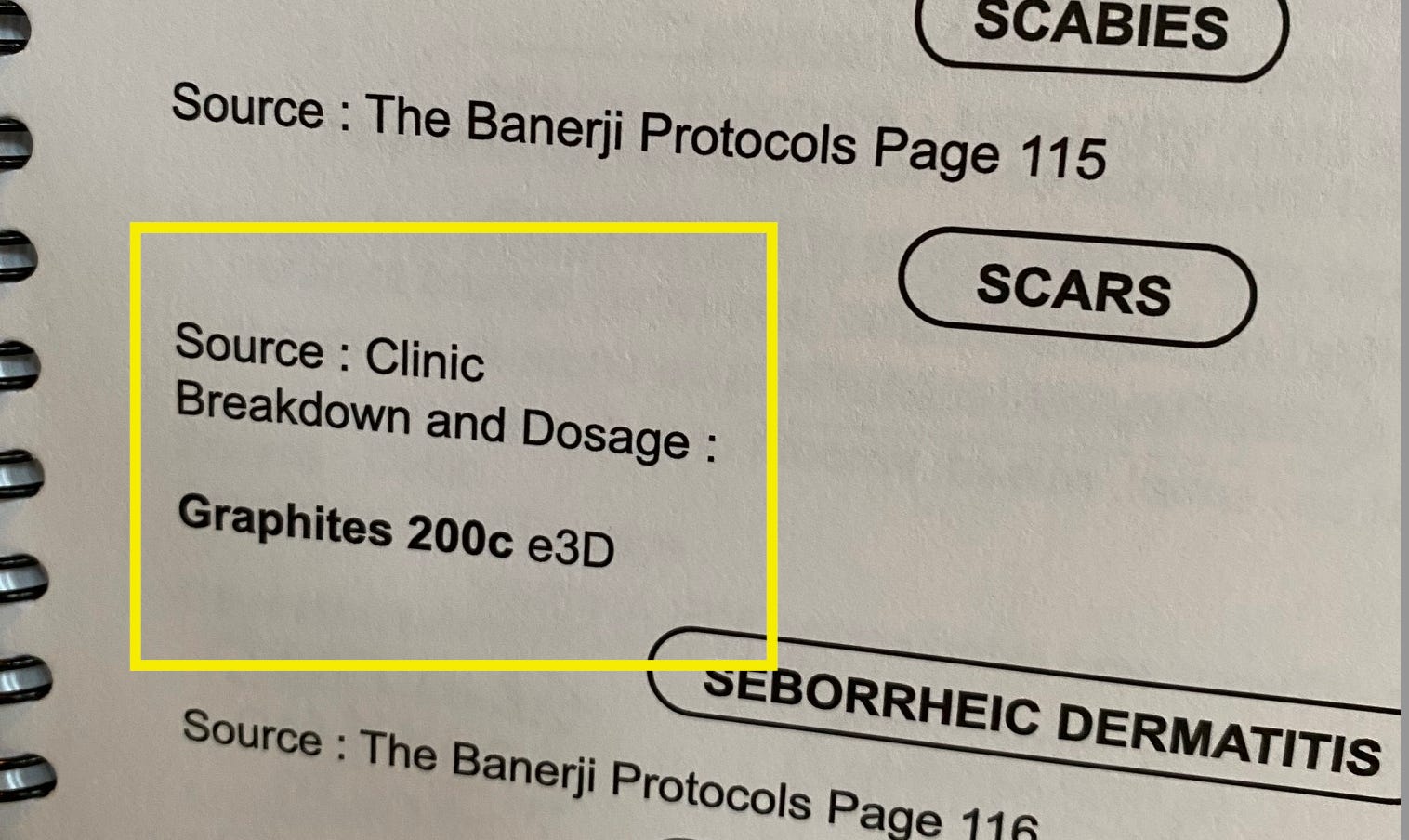
In almost all of the protocols where you find Graphites 200 it will be used every third day. (That means one dose every three days.)
When using the protocols as a template, it doesn’t matter if the remedy shows up in Line 1, 2 or 3. That’s not the point.
You are using the Banerji Protocols to give you a starting place for how to dose the homeopathic medicine you have chosen.
In this example I have no idea what condition you want to try it for, I’m just giving you an example of how the Banerjis would have used Graphites as a medicine.
And you can assume that they came to this potency and frequency after seeing thousands and thousands of cases. (This is not random. It is clinical homeopathy!)
So, you could conservatively start by using Graphites 200C once dose every third day.
Now, I will tell you that for issues such as nail fungus, I have found that using Graphites 200C once a day greatly speeds the process, so far without any problems.
This I discovered through experience. It’s not that every third day won’t work, but it will take longer in a condition that is as sloooooow to treat as nail fungus.
But, if I was passing a Graphites-related protocol along to someone that I might never see again, I would give the original protocol.
If it is someone I am observing and working with (including myself), then I might adjust.
If you are nervous, just start with what is in the protocols. Because I will tell you again, these are conservative and often for the long term, and they are also very effective given time.
If you don’t notice anything to start, that is just fine, just keep going and only assess every two months (at the soonest).
Remember to take photos if you can, and keep observational notes, so that you can honestly tell if there has been any progress in the right direction.
In which case, keep going!
If you start to get worried about aggravations and provings, let me add a few notes here:
• You can read my articles on Homeopathic Aggravations and Homeopathic Provings.
• Remember that repeating remedies daily actually decreases the occurrence of aggravations.
• The fact that we are not trying to the treat ‘the whole person’ using the classical method— but instead are working with the current conditions and symptom picture— also reduces the numbers of aggravations as well. (More on why in my next article on miasms and nosodes.)
• Lastly, provings are actually a lot less common than you would imagine, and are easy to manage if they do occur. When in doubt, just stop taking the medicine for a few days and see!
How to Use The Banerji Protocols as a Template For a Condition That Is Not Specifically Listed as a Protocol—
Now let’s look at a slightly more complex example—
In this case let’s say you are dealing with a heart condition that does not show up as an exact match for any of the diagnosed conditions in the Banerji Protocols, so you are wondering what to do.
(If you find a match for your condition, just use the protocol! Here we are learning what to do when there is no clear match.)
Now we begin by looking through the protocols for everywhere the words heart and cardiac— and any related terms — appear.
And we find protocols such as—
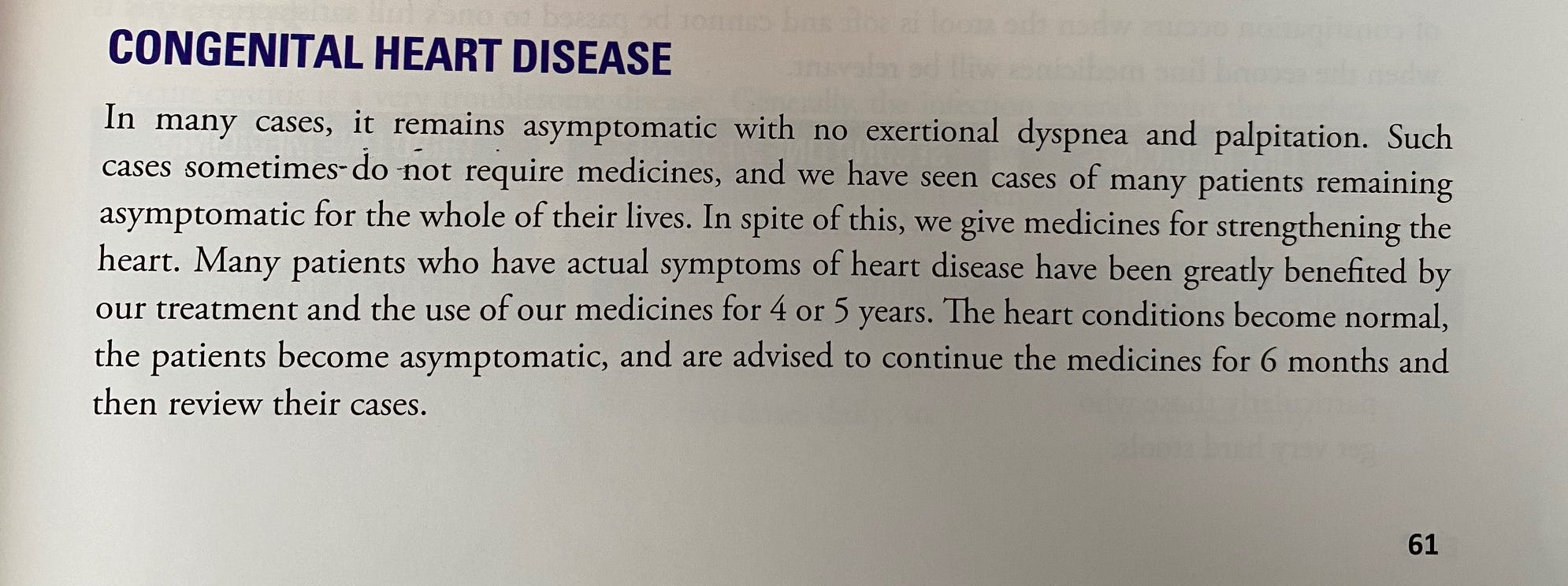
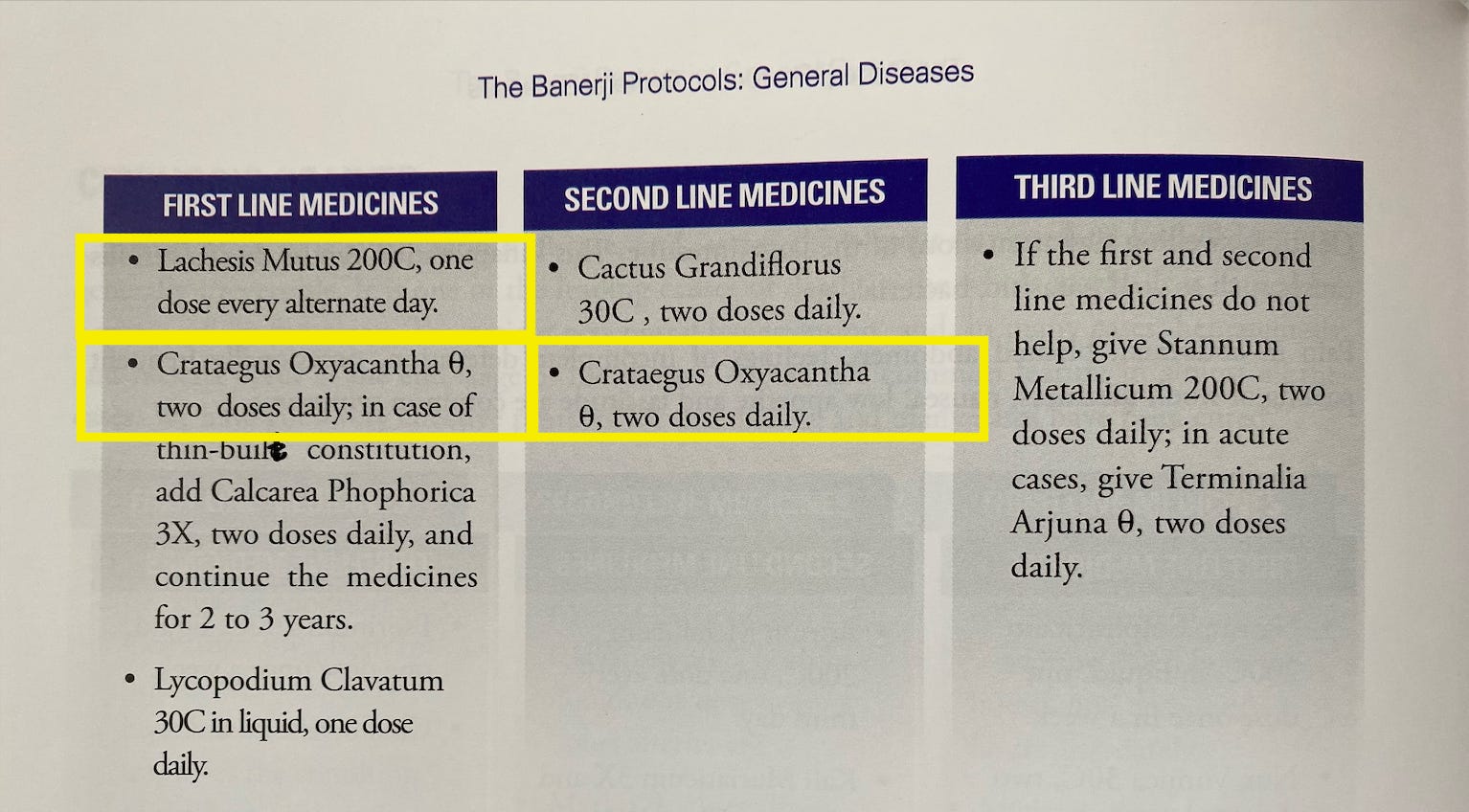
Congenital Heart Disease (see images below)
Rheumatic Heart Disease (RHD)
Atrial Fibrillation (Tachycardia)
Coronary Artery Disease (CAD)
Ectopic Heart Beats
Triple Vessel Disease (TVD)
Heart Murmurs
As you go, DO NOT skip over related notes within seemingly unrelated protocols.
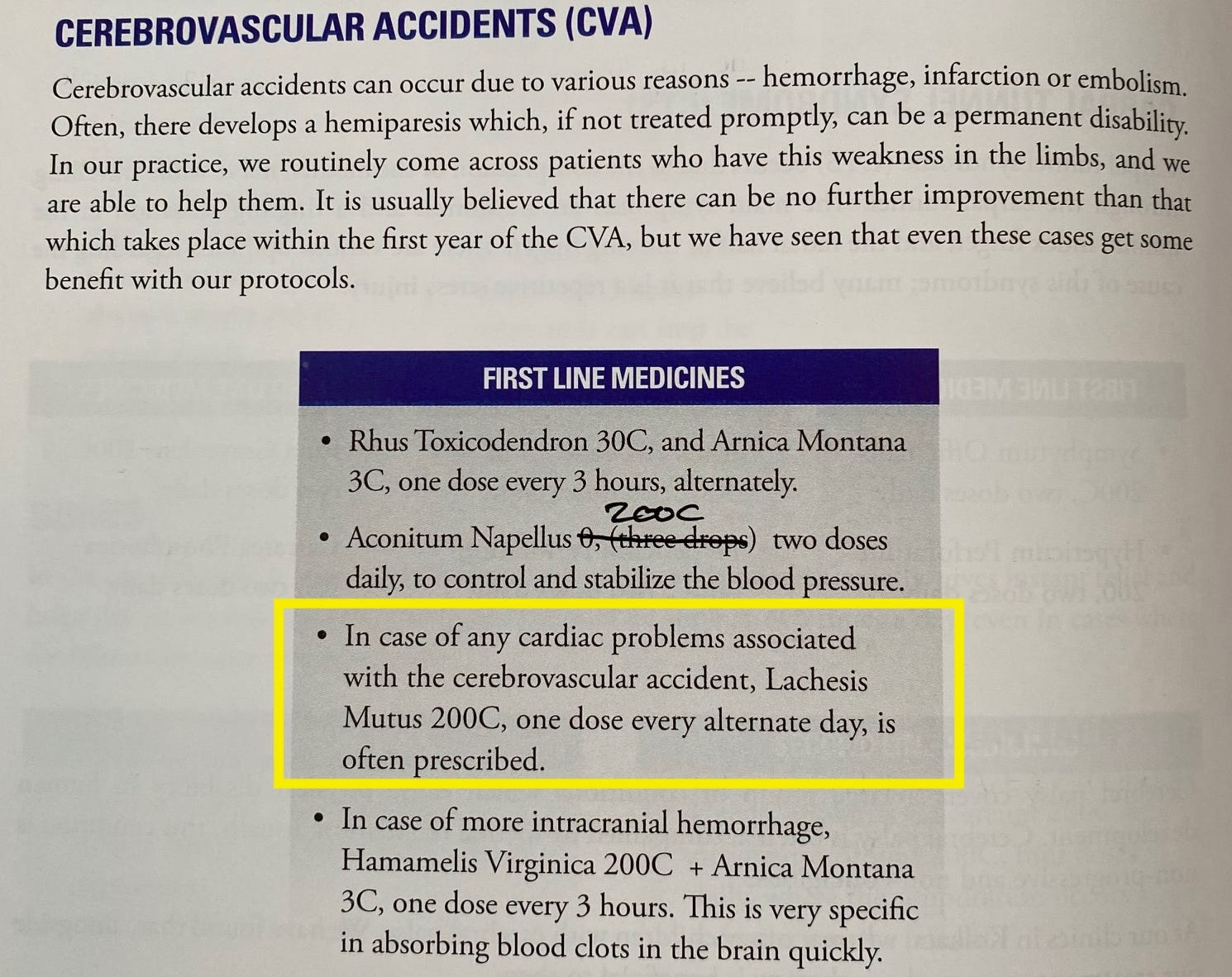
For example, ‘in case of cardiac problems’ or ‘for tachycardia’ are notes that are found under CVA (aka Stroke- see photo above), under the protocol for Paralysis from CVA, and within the Lupus protocol.
(Also, do not skip what we refer to as the ‘Space Remedies’ found in the charts in Chapter 6 at the back of the original book. There’s a bonus gold mine in there as well.)
Take notes as you go and look for common denominators— which remedies are being used time and again for all of these somewhat related conditions?
In this example, we discover a couple of medicines used repeatedly in all sorts of heart conditions—
Lachesis Mutus 200 every other day
Crataegus Oxyacantha θ twice a day
[Reminder that θ, or Q, means MT/Mother Tincture, or zero potency, aka herbal tincture.]
You will also find that Lachesis 200C occasionally shows up in protocols twice a day.
Good to know, so we now have a range from every other day to twice a day.
You might also note that Crataegus is used in a 6X in the ‘space remedies’.
(A low potency is much more convenient and durable than a mother tincture. And this is how I typically use most of the remedies that are called for as mother tincture— in a 3X or 6X, whatever is the lowest potency available.)
I also have the following protocols from my year with the Academy of Practical Homeopathy, Joette Calabrese’s school. (Joette visited the Banerji clinics in India many times and so she also has additional protocols from watching them work.)—
Atrial Septal Defect
Aortic Stenosis
Pericardial Effusion
Cardiomegaly
Congestive Heart Failure
Cardiac Arrest
Chest Tightness
Arrhythmias
Palpitations
In all of these cases we see the same homeopathic medicines pop up over and over again. (There may be other medicines included, and depending on your situation you may or may not choose to include them as well.)
Again, Lachesis and Crataegus show up repeatedly, often both in the same protocol.
In fact, we were taught that if there was no protocol and we weren’t sure where to start, that the baseline cardiac/heart protocol was:
Lachesis 200 every other day
Crataegus MT twice a day
Which just makes logical sense, because The Banerjis used these homeopathic remedies so often in these types of conditions.
So we don’t have to guess. And having the above example confirmed by someone who met and observed the Banerjis in action, backs up this approach in general.
And just FYI, Crataegus (also known as Hawthorne) is generally known as a heart tonic.
While you are at it, get out your homeopathic Materia Medica and read about these medicines. But do not discard them because they don’t read as an exact match. That is not how the Banerjis used them (e.g. person to remedy). These are condition to remedy.
Sometimes even top medicines they used hardly register in the homeopathic repertories for the condition. (One example is Helonias for diabetes.)
This is because their entire focus was in practice, not in theory or textbooks.
Now, if you want to try this out for yourself, you can scan through the books to find all the protocols where Lachesis Mutus and Crataegus Oxyacantha are employed.
And you will start to discover for yourself the scope of these medicines.
You will also see that Lachesis is used frequently in pulmonary/lung protocols— such as in the protocols for Interstitial Lung Disease (ILD) and Sarcoidosis, SARS, RSV, bronchitis, pneumonia, asthma and others…
It also is found in protocols for menopausal issues and hot flashes, uterine hemorrhage, paralysis, bed sores, varicose veins and varicose ulcers…
As well as in protocols for Alzheimer’s, ADD/ADHD, Cerebral Palsy, Depression, Diphtheria, Parkinson’s, Poliomyelitis, Epilepsy and Epistaxis (nose bleed).
The Banerjis used Lachesis Mutus quite often!
Do note that Lachesis is not always in Line 1, so it may not be the first choice in some of the above listed protocols.
However, we are just getting an idea for how this medicine might be used.
Just by studying Lachesis in the Banerji Protocols you can learn SO MUCH about how you might be able to use this homeopathic medicine.
And if you have multiple conditions (as many people do), and Lachesis appears in Line 1, 2 or 3 for more than one of your conditions, that might be even more evidence to back up your choice of this remedy.
(And, yes, we can use multiple protocols at the same time as well.)
This way of looking at the Banerji Protocols will show you what kinds of conditions specific medicines were used for. And this is a great way to learn.
Instead of a rigid perspective that thinks a homeopathic medicine can only be used in one specific manner, we start to see ALL the ways it might be used. And this is a very useful way to get started with and gain confidence in homeopathy.
(Eventually we must just pick our medicine(s), START, and observe. There’s no way around this with homeopathy. Based on what happens, we adjust as needed!)
A few more practice examples—
Let’s say you want to use Carbo Animalis, but aren’t sure what potency or frequency to start with.
Again, just scan through all the pages of both Banerji Protocol books and you will discover that Carbo Animalis is used in a 200C twice a day, and in some protocols up to four times a day.
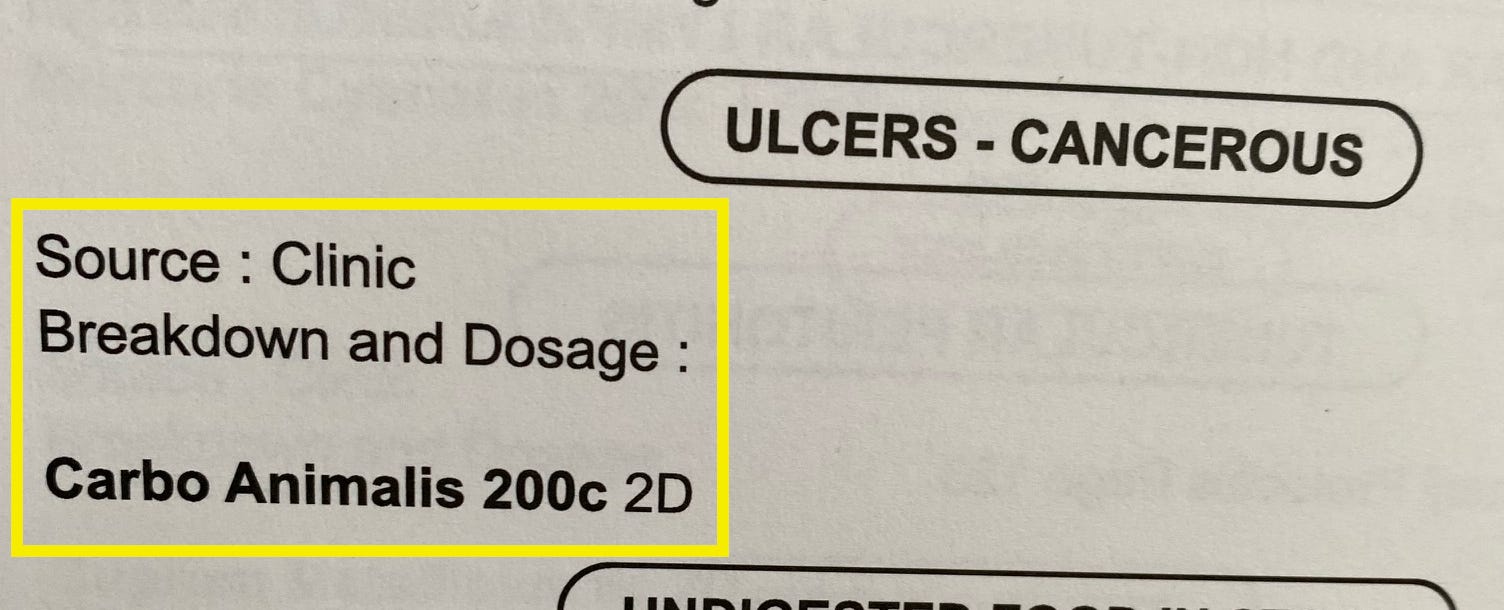
So we might conclude that twice a day could be a good place to start, keeping in mind that it also might be used more often, if needed.
Now let’s say you are looking for help with something more general, such as a remedy for bleeding. That is not a headline protocol that you will find in the index.
However, hidden within many of the protocols are notes such as—
‘in case of bleeding’…
or ‘in cases of patients who had melena or hematemesis’…
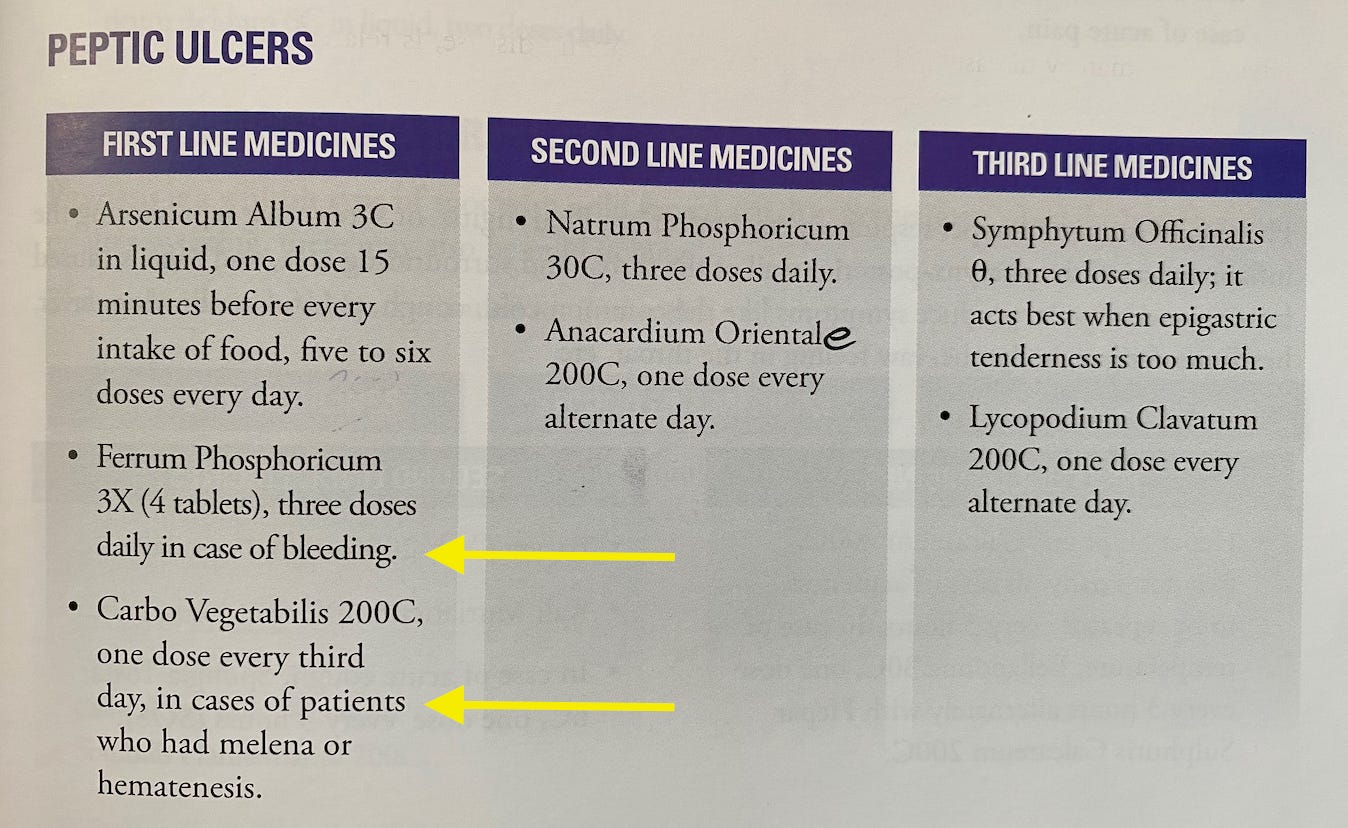
[Melena is black stool caused by bleeding in the GI tract. And hematemesis is vomiting of blood. Note: Hematemesis is misspelled in the book. Yet another book correction!)
For bleeding you will frequently find Ferrum Phos 3X.
(You can skip the 4 tablets note, that was for the Banerji pharmacy in India. Use the dosage of the homeopathic pharmacy you are using.)
In this case, I would choose a low potency, possibly whatever I had on hand under 30C— unless it was a chronic condition, then I would purchase the 6X, which will be the most easily found.
(Even Helios doesn’t carry Ferrum Phosphoricum in anything under a 6X. In virtually all cases the Banerjis used 3X, and we would use 6X. It’s just what is available by country.)
There are other options for bleeding, for instance Arnica 3C shows up in the same manner within various protocols, so this might also be used.
(If you already know something about homeopathy, you might also think of a remedy such as Phosphorus for bleeding. Interestingly, you won’t find Phosphorus used much at all in the Banerji Protocols. This could be simply because we all have our favorite remedies, and there are always others that could be used. Although, I wonder if it might be in part because Phosphorus is a bit more intense as a remedy, and is not for everyone. There are those who do wonderfully on Phos, and many who don’t. So it would not be a homeopathic remedy that I would choose to send someone away with to take unsupervised for an extended period of time, especially if I had other options.)
More examples that I have already written about—
I have already discussed musculoskeletal conditions quite a bit, introducing this protocols-as-templates concept in the article Homeopathy for Pain.
It’s an important topic, in particular for acute muscle and joint pain, because most of the potency and frequency recommendations that you will find in the Banerji Protocols will be far too conservative.
For example, Rhus Tox 30C twice a day over years may be (and often is) helpful for chronic muscle and joints issues, but in most cases it will not touch the person’s current excruciating pain.
In these cases we need something more— often in addition to the baseline protocols— that can match the intensity of the pain. Meaning higher potencies and more frequent dosing. Which is why I wrote the article on Homeopathy for Pain— it’s such an important topic.
I will be writing even more on this topic when we start to discuss megapotencies.
(I don’t believe in using just one tool. Would you want to build a house with only a hammer?)
You can also find more examples of using the Banerji Protocols as a template in the article, ‘An Example of Using the Banerji Protocols’, where I chose Tarentula for neuralgia.
And don’t forget the index I created of all the Banerji Protocols to help you search, and where you will also find the Banerji Emergency Medicines, which you can use to help you select homeopathic medicines for acute issues.
There is also the Banerji COVID protocol, which is not just for COVID but any condition like that.
The protocol indexes included at the back of the Banerji Protocol books are not very helpful, and even the titles of the protocols and the organization of the books leaves a lot to be desired. Your best bet is to scan the pages for what you are looking for. And to use the searchable index that I created for you.
Lastly, don’t settle for how the Banerjis used a particular homeopathic remedy in just one or two protocols. Find all of the examples in the books and you will discover the full range of use, which might be from twice a day to once a week. If you only see the once a week examples, you will be missing out on important information!
A few final notes on the Banerji Protocols—
Through clinical practice, and working with so many patients for so many years, the Drs. Banerji disproved many commonly held notions (or myths) in homeopathy.
They never mention anything about antidoting of homeopathy. There is no discussion of coffee, mint, etc, and very little mention of diet.
One of the beautiful things about repeatedly dosing the homeopathic remedies is that even if one dose is antidoted, you are just going to take it again!
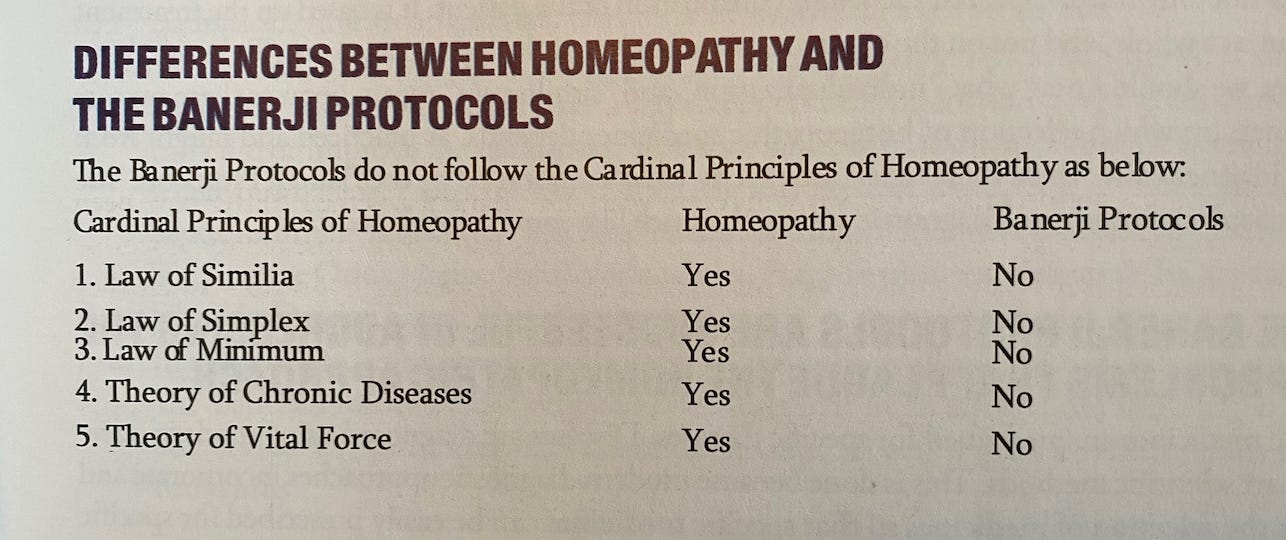
They also did not work with the concept of ‘like cures like’ in their daily practice. (See image below.)
They didn’t take full cases and then search for medicines that matched.
They often had 15 minutes with a person and then sent them off to take the medicines on their own.
With these protocols, the individual details of the person don’t matter.
We are giving remedies for conditions, not for ‘the person’ or any constitutional factors.
We don’t choose a lower potency or lesser frequency because the person is small, or young, or old, or the animal is a puppy instead of a dog.
These are not factors— it is the condition we are basing the selection on.
They also used dry doses as as standard. (When it says ‘in liquid’, that means the medicine was prepared in liquid, not made into wet doses from pills— again this was for their pharmacy, and you will just use what you have access to.)
I use all of the Banerji Protocols in wet doses.
Both work, it is your choice.
(And those homeopaths who claim that repeated dry doses of C potencies is dangerous in some way, well the Banerjis have thoroughly disproved this.)
The Banerji Protocols are an excellent teaching guide for how to use homeopathic medicines in a very practically applied way.
I hope that you will take full advantage of the Banerji Protocols, as they are so much more than just a list of some protocols!
The Banerji Protocol books can serve as a beautiful learning template, and there are great depths to be plumbed in the knowledge they left to us.
Please remember— This information is for your educational enlightenment. I do not diagnose or prescribe and I do not know your particular situation. These pages are for you to use (or not) as you see fit in your life and for your loved ones.
As always, thank you for reading and subscribing.
Until next time!
All support — reading, sharing and financial — is deeply appreciated.
If you enjoyed this article, give it a heart ❤️!
• New to Homeopathy?— Check out Homeopathy Rising: A Step-by-Step Guide.
• Each month, join us for a Live Homeopathy Q&A session. (Held on the first Tuesday of every month.) The email reminder and Zoom link gets sent out two days prior. Ask questions even if you can’t attend in person. For paid subscribers. (Only $6 per month or $60 per year!)
• And if you want to go deeper, consider the Homeopathic Practitioner Mentorship which also meets once a month, on the third Tuesday of every month, and includes a private Chat group. Learn more here.
• If you are looking for a Homeopath to work with— I get inquiries through Substack almost weekly; but, unfortunately, I am not taking new clients, and have not been for some time. However, I have been adding associates to my practice, those I fully trust and recommend. You can find out more at RoaringForkHomeopathy.com
• Follow Homeopathy Rising on X.
• Follow me on Substack Notes. Typically I try to post the same content to X as I do to Substack Notes. (And which is different than these long-form articles.)
• Check out the Homeopathy Rising Archive where you can locate all past articles and videos, in order. These posts build from the most basic (such as how to find a Banerji Protocol or how to make a wet dose) to much more advanced topics related to homeopathy and healing.
**If you are a person who likes to print articles, here are tips on how to do so.**
***If you prefer to listen to articles being read to you— use the Substack App, find the article, and press the little ‘play’ button in the top right corner. Look for the same symbol you would use to play music on your device or on a DVD player.***
Hi Emily, this article is so helpful! Life changing! Thank you! My question is if we can combine remedies together in a wet dose. I might have seen your answer to this before and I think you said yes. For example, I am taking a 2D remedy for high blood pressure and another for arthritis ( each of those having two remedies in each protocol. Can I make a wet dose ( using your instructions on that) and mix them in water, shake e@ch time, keep in fridge and take a sip twice a day. Will I get the same benefit as taking them dry? And all mixed together? Yes I know Joette says to separate them and use dry. The Benerji gave them separate to their patients I was told? But Cristina says to mix them. What do you think? Thanks so much for a reply!
Hi Emily,
If a person is taking Calc Carb 200 once a day for allergies but would like to add Calc Carb 1M once a day for emotional symptoms, can they take both of these potencies in the same day? Thank you! :)